This Saturday I gave two tours to small groups of visitors. Both tour groups were very knowledgeable about the USS Slater and Destroyer Escorts. The people in the first group were repeat visitors. They appeared to be very impressed with the progress of the restoration effort since their last visit (approximately five years ago). The Slater's crew is always trying to improve the state of the ship and expand the tour experience. There's also a lot of restoration effort that goes on behind the scenes. Because of accessibility reasons many of these areas are not included on the standard tour. I recommended that they consider the USS Slater's Hard Hat Tour so they could explore areas of the ship that they haven't seen before. Some of the more interesting areas are the Flying Bridge, the Engine Room, and the Motor Room. While these spaces are not open to the public because of accessibility, there have been significant restoration efforts in them.

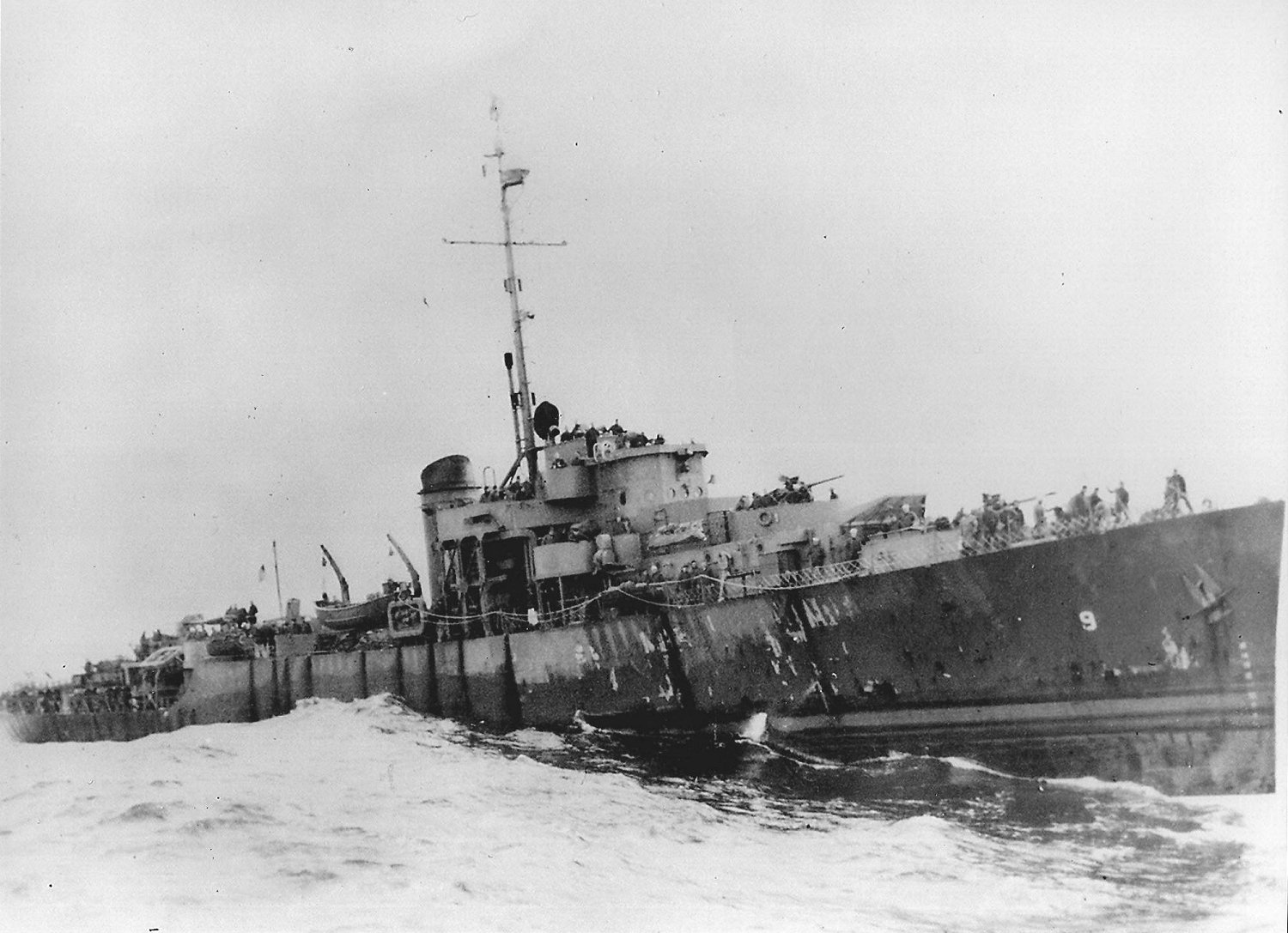
USS Ahrens (DE-575)

USS Block Island - Final Moments
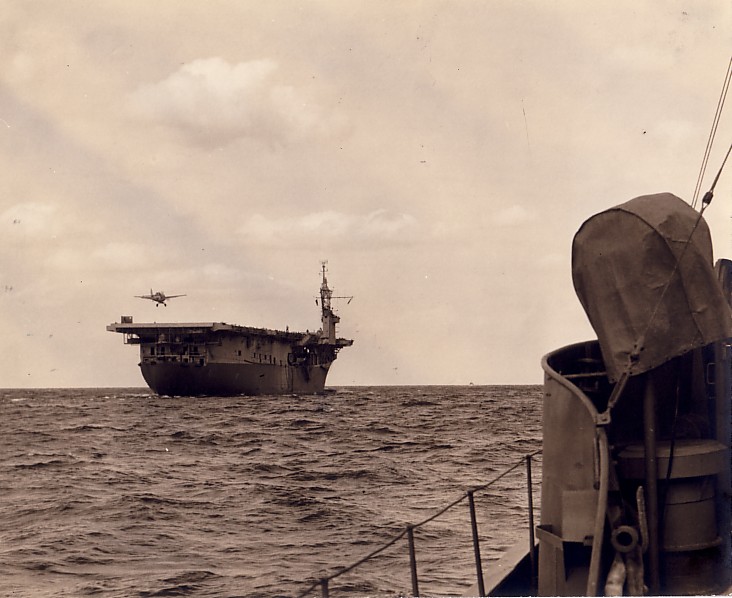
The USS Block Island (CVE-21) was an escort carrier. In 1944, the Block Island, along with four Destroyer Escorts (including the Ahrens) formed a Hunter-Killer Team (TU 22.11). Hunter-Killer teams would actively search an area for U-Boats. Radio Activity and decoded U-Boat messages (from Bletchley Park) would direct the Hunter Killer team to a region. Since a U-Boat would spend most of the time on the surface, patrol planes from the small carrier would narrow the search. Once a U-Boat was found a pair of Destroyer Escorts would be dispatched to finish the U-Boat. Two DEs would continue to escort the Carrier.
In response to the Hunter-Killer Groups, in 1944 the German U-boat command started to arm U-Boats with Acoustic Homing Torpedoes. They also implemented an offensive strategy to sink the escorts: "......Offense is the best defense...... If the enemy bears down on you, do not blind yourselves by going to great depths, but in the daytime remain at periscope depth and fire. You still have enough time after firing to dive. The same applies at night, first fire, then dive. Offense is the best defense. Act accordingly...... "
On May 29, 1944 the USS Block Island was torpedoed by three torpedoes from U-549. The USS Ahrens and the USS Robert I. Paine (DE 578) assisted the USS Block Island. Two other Destroyer Escorts in the group, the USS Barr (DE-576) and the USS Eugene E. Elmore (DE-686) attacked the U-549. The U-Boat was equipped with the newly developed Acoustic Homing Torpedoes, and managed to cripple the USS Barr. The Ahrens and the Paine were stationary during the rescue, and they would have been an excellent targets. It was probably a race, would the Elmore get U-549 before another DE was hit. This survivor's account details the action: ".....At 2040 Captain Hughes ordered all hands to “Abandon Ship”. By 2100 most men went over the starboard side, either jumping or sliding down knotted 40-ft. Rope ladders. As the ship sank the planes spotted on deck slid into the sea like toys, the TBM’s depth changes exploding deep under the surface. Block Island took her final plunge at 2155. We were equipped with various types of life belts / jackets as well as cork supported rope nets. ........... The USS Ahrens DE 575 stopped engines and drifted to a stop in the Atlantic swells, recovering the Block Islanders from the sea. With Ahrens’ engines now stilled, her sonar almost immediately detected U-549. Ahrens skipper radioed the USS Elmore DE 686 coaching the sister ship to where the German submarine lay. Three projectiles from Elmore’s hedgehogs slammed into the U-549’s hull at 2127. A great, grinding internal explosion audible to the monitoring ships destroyed the U-boat a moment later.
A postscript to this story - it appears that the Ahrens was being stalked by U-549. An Ahrens crew member, Maury Gamache was given credit for spotting U-549. Perhaps his sharp eye saved DE-549 (and many of the Block Island survivors): ".....I normally was assigned to the depth charge and K gun area but while we were picking up survivors I was sent to the 101 gun mount, along with an ensign. While I was there he told me to keep a close look out to the opposite side where the survivor activity was taking place, which I did with an occasional look in that direction. After a while, I think it was just after dusk, I saw a periscope on the left side of the ship and I was so speechless that I tapped him on the shoulder and pointed and he saw the same periscope. He immediately notified the bridge and that is when the Ahrens had to break off the picking up of survivors and make emergency speed to avoid being sunk also. ...."

Part of the Block Island Crew in Casablanca
The Ahrens was credited with rescuing 673 sailors from the USS Block Island. The small Destroyer Escort, with it's own crew of 213, had 886 sailors on-board. About a month ago the Slater hosted an open house and had several thousand visitors, but I doubt that 886 were aboard an any given time. I'm pretty sure that a ships baker had his hads full feeding this many sailors. The account from rescued Block Island sailors continues: ".......The next morning, 30 May, Elmore with the damaged Barr under tow, and the two DE’s laden with the CVE survivors, cleared the area for Casablanca, arriving 1 June. The personnel of the two DE’s, did a commendable job of making all hands as comfortable as possible, some giving up bunks for others to catch a few winks. The task of feeding this large number, aboard the Ahrens and the Paine, was without parallel. While we were lined up on the main deck, waiting turns to go below to eat our two meals. Sometimes, from the bridge came the order for some men to shift from one side or to the other to maintain an even keel. The odor of diesel fuel oil was everywhere that we touched. My what a mess! However, we were SAFE. ....."
Other interesting links regarding the USS Block Island & the USS Ahrens:
When ships are packed into convoys of 50 plus ships accidents are bound to happen. The worst ones occur when one of the ships is carrying a highly explosive cargo. On the 13th of October, 1944 the Liberty Ship Howard Gibson and the British gasoline tanker George W. McKnight collided. The USS Holton (DE-703), USS Cronin (DE-704), and the USS Ahrens (DE-575) were involved with the rescue. Once again, Lewis Andrew's excellent book, Tempest, Fire and Foe gives an excellent account on page 58.
This will be my last duty weekend until April 2008. In early December the USS Slater will move to the east bank of the Hudson River to protect the ship from winter ice. It will be closed for tours until she returns to the Albany-side in April. During the winter I'll continue to post to the blog. If anyone has a topic request concerning Destroyer Escorts e-mail me.


_launches_a_TBM_Avenger_for_attack_on_U-544.jpg)


